

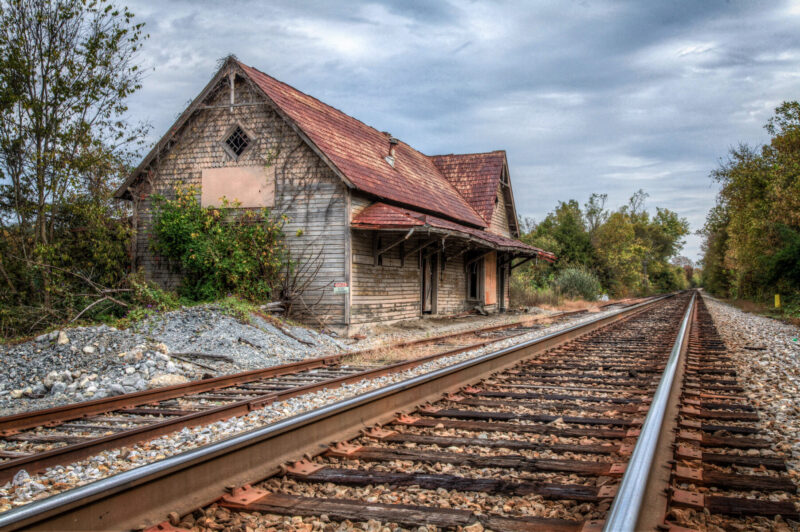
An old abandoned railroad track in rural Texas.
Railroads played a transformative role in Texas history, turning a largely frontier economy into one of the most productive commercial regions in the United States. Before rail lines were introduced, long-distance travel across Texas depended on stagecoaches, wagons, and river routes, all of which were slow, costly, and heavily dependent on weather and terrain.
The arrival of rail infrastructure in the mid-19th century changed that reality almost overnight. Towns that were once isolated became connected to Gulf Coast ports and national markets. Agricultural goods, especially cotton, could move faster and in much larger quantities, helping fuel rapid economic expansion. Over time, railroads did not just support Texas growth—they actively reshaped where cities formed, how industries developed, and how people moved across the state.
The Early Days (Pre-Civil War)
Rail development in Texas began cautiously in the decades before the Civil War, shaped by limited capital and a still-developing political structure.
Early efforts included ambitious but unrealized plans as well as the first operational rail lines in the state. These early projects laid the groundwork for what would eventually become a statewide network.
Key developments during this period include:
1836: Early Chartering Efforts in the Republic of Texas
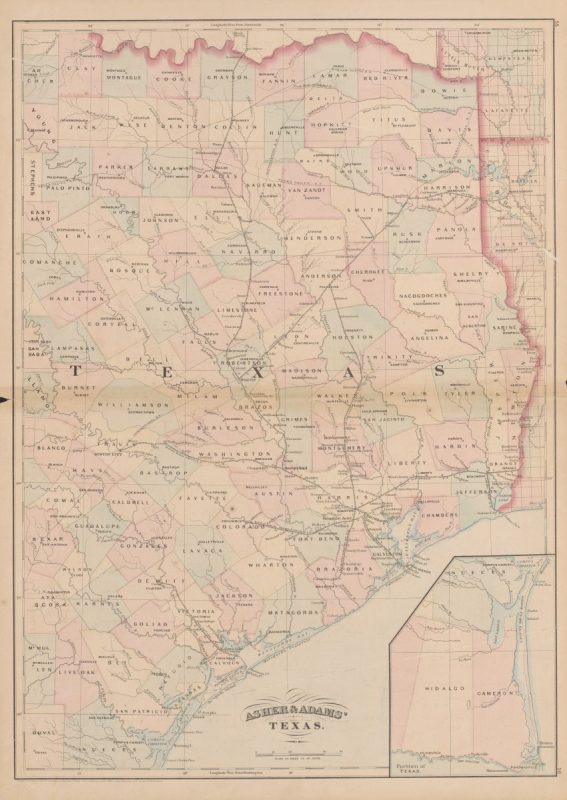
This map depicts the railroads and counties of eastern and southern Texas, shortly before the Financial Panic of 1873.
In 1836, shortly after gaining independence from Mexico, the Republic of Texas authorized its first railroad charter. At the time, railroads were seen as a forward-looking investment that could help connect scattered settlements across a vast frontier and strengthen trade routes.
However, despite the official approval, no actual construction took place under this early charter. Limited capital, political instability, and the challenges of building infrastructure in a young republic meant that railroad development remained largely theoretical during this period.
Key context behind the early chartering effort:
- The Republic was focused on establishing basic governance and defense systems
- Infrastructure projects relied heavily on private investment, which was difficult to secure
- Most transportation still depended on horses, wagons, and river routes
- Rail technology was still emerging in the United States, making investment riskier
Although no tracks were laid in 1836, this early authorization marked the beginning of Texas’s long-term vision for rail-based development.
1853: The First Operational Railroad in Texas
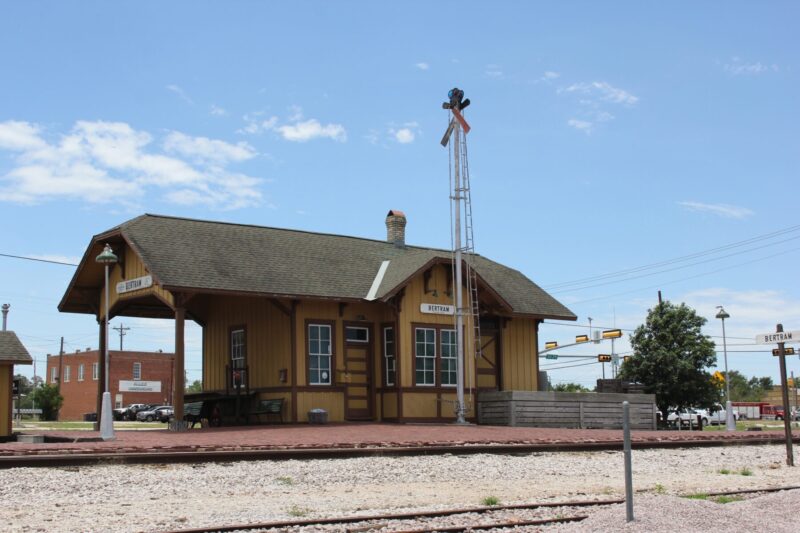
A historic train depot with a library in the background in Bertram, Texas.
A major turning point came in 1853 with the opening of the Buffalo Bayou, Brazos, and Colorado Railway (often abbreviated as BBB&C). This line became the first functioning railroad in Texas, establishing a 20-mile route between Harrisburg (now part of modern-day Houston) and Stafford.
While modest in length, this early rail line had an outsized impact. It demonstrated that rail transport could operate successfully in Texas’s difficult terrain and quickly move goods between inland communities and Gulf Coast trade hubs.
Significance of the BBB&C Railway:
- First successful demonstration of rail transport in Texas
- Connected agricultural areas with shipping access along the Gulf Coast
- Reduced travel times compared to traditional stagecoach routes
- Helped establish Houston as a growing commercial center
The success of this short line encouraged further investment and set the stage for rapid railroad expansion in the decades that followed.
1861: Rail Growth on the Eve of the Civil War
By 1861, Texas had expanded its rail network to approximately 470 miles of track. While still limited compared to more industrialized states, this represented significant growth in less than a decade. Most of the rail infrastructure was concentrated in and around Houston, linking inland agricultural regions to Gulf Coast ports.
Rail development at this stage was increasingly tied to commerce, especially the movement of cotton and other agricultural goods. However, the onset of the Civil War in 1861 disrupted further expansion and redirected resources toward wartime needs.
Key characteristics of Texas railroads by 1861:
- Roughly 470 miles of operational track statewide
- Strong concentration around Houston and Gulf Coast trade routes
- Primary focus on agricultural exports, especially cotton
- Growing importance in regional trade and settlement patterns
Even though expansion slowed during the Civil War, the foundation laid before 1861 positioned Texas for the massive railroad-driven growth that would follow during Reconstruction and the late 19th century.
These early rail lines were relatively short, but they introduced a new model of transportation that would soon scale rapidly after the Civil War.
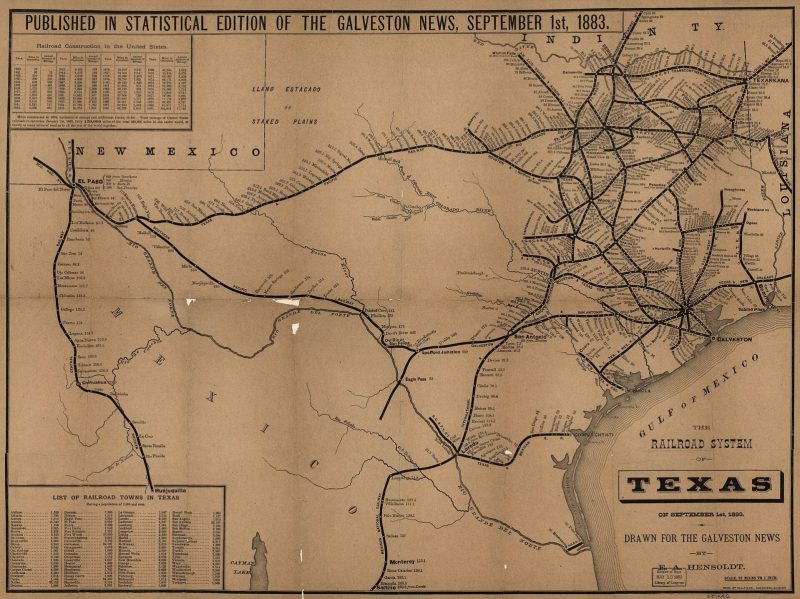
The railroad system of Texas on September 1st, 1883.
The Expansion Era (Late 19th Century)
The post–Civil War period marked a dramatic acceleration in railroad construction across Texas. Reconstruction-era policies, private investment, and population growth combined to create ideal conditions for expansion.
One of the most important incentives used during this time was land grants. The state provided large tracts of land to railroad companies as an encouragement to build new routes. This helped finance major infrastructure projects that would have otherwise been too expensive or risky.
Several defining changes shaped this era:
- Rail companies expanded outward from early hubs like Houston, pushing lines northward toward Dallas and beyond.
- The Houston and Texas Central Railway helped connect central Texas cities to northern trade routes.
- The Texas and Pacific Railway aimed to establish broader east–west connectivity across the state.
- In 1872, the Missouri, Kansas, and Texas Railroad—commonly known as the “Katy”—became the first major northern rail line to enter Texas.
Railroads also began reshaping urban geography. Instead of river-based trade towns, rail junctions became the new centers of growth. Cities like Dallas and Fort Worth expanded rapidly because of their strategic positioning along key rail lines.
Economic Impact
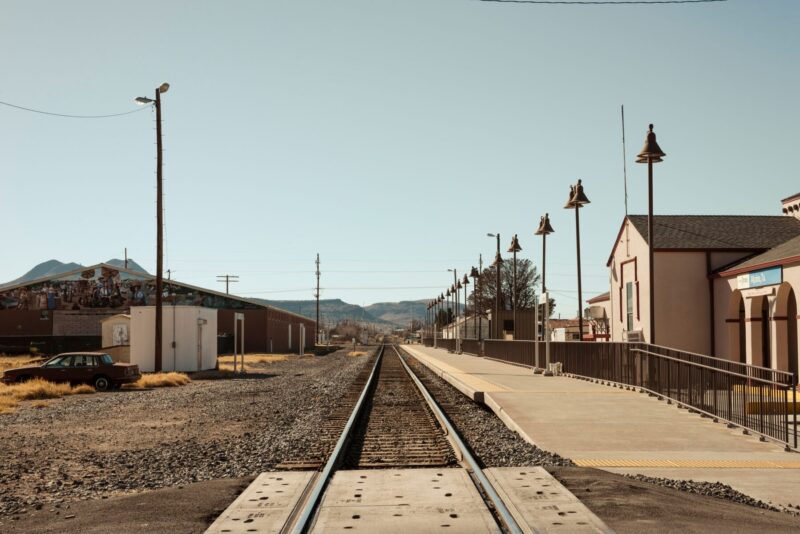
Railway lines lead west out of town in Marathon, Texas.
Railroads had a strong and lasting economic effect on Texas, influencing agriculture, trade, population distribution, and even government regulation.
One of the most immediate impacts was on agriculture. Farmers gained access to faster and more reliable transport routes, which reduced spoilage and expanded access to national markets. Cotton, in particular, became far more profitable due to improved shipping efficiency.
This economic shift also contributed to rapid demographic and financial growth:
- Texas population tripled between 1860 and 1890 as rail access made inland settlement more practical.
- Property values increased dramatically over the same period, reflecting rising commercial activity and land demand.
- Agricultural output expanded as farming became more commercially oriented rather than purely local.
Rail expansion also led to the creation of regulatory oversight. In 1891, the Railroad Commission of Texas was established to address unfair pricing practices and monopolistic behavior in freight shipping. Although it originally focused on railroads, its responsibilities later expanded significantly into oil, gas, and pipeline regulation.
Modern Legacy
Although railroads no longer dominate passenger travel in Texas, their historical influence remains visible in both infrastructure and cultural preservation efforts.
Modern rail use in Texas is primarily freight-based, but heritage railways still preserve the experience of early train travel. These restored routes allow visitors to engage with Texas history in a tangible way, often using original or refurbished equipment.
Some notable examples of this legacy include:
- The Texas State Railroad in East Texas, which operates historic steam and diesel trains through the Piney Woods region.
- Seasonal tourist excursions that recreate 19th-century rail travel experiences.
- Preservation efforts that maintain historic rail corridors and infrastructure for educational and cultural purposes.
These heritage operations serve as living reminders of how railroads shaped Texas development and continue to attract tourism and historical interest today.
The Lasting Impact of Texas Railroads
Texas railroads fundamentally reshaped the state’s economic and geographic development. What began as short experimental lines quickly evolved into a vast transportation network that connected agricultural regions, supported urban growth, and enabled large-scale trade across the United States. While their role in daily transportation has changed, their historical impact remains deeply embedded in Texas’s cities, industries, and infrastructure.
Additional Readings on Railroad History in Texas and the USA
-
- A Timeline of the History of Texas
- What Really Started the American Civil War?
- Civil War Facts: 1861-1865
- U.S. History and The Civil War: Years of 1860–1865
- A Brief History of the Texas Railroads
- Galveston Railroad Museum: Railroad in Texas
- First Railroad in Texas Chartered
- Hazardous Business: The Railroads Come to Texas
- How the Railroad Transported Prosperity Across Post-Civil War Texas
- The History of the Buffalo Bayou, Brazos, and Colorado Railway
- Learn More About The Buffalo Bayou, Brazos, & Colorado Railway
- The History of the Katy Railroad
- History of the Railroad Commission of Texas
- Texas State Railroad: A Historical Overview
- 7 Great Vintage Railways in America
- The Journal of the Civil War Era: Reconstruction in the West
- The Civil War and Reconstruction in the American West
- The Texas Revolution and the Republic of Texas: A Brief History
- History of Texas: Exploration, Revolution, Annexation
- Railroad Tourism in Texas: A Journey through Time
- Traveling through Texas' Past Aboard a Vintage Train